How often should a new homeowner change their furnace filter?
Most homeowners in the Twin Cities should change their furnace filter every 1–3 months, depending on filter type, home size, and whether you have pets. When in doubt, check it monthly and replace it when it looks gray and clogged.
If you just bought your first home - congratulations. You're officially in the club where unexpected expenses feel like a full-time job.
Here's the good news: furnace filter maintenance is one of the easiest, cheapest things you can do to protect your home. And yet, it's one of the most misunderstood. I talk to new homeowners all the time across the Twin Cities who either haven't thought about it at all, or they went out and bought the "best" filter on the shelf - and actually made things worse.
Let's fix that.
Why Your Furnace Filter Actually Matters
Your furnace doesn't just heat your home - it circulates air constantly. The filter sits at the return air duct and catches dust, debris, pet dander, pollen, and everything else floating around your house before it gets pulled through the blower and back into your living space.
When the filter gets clogged, your furnace has to work harder to pull air through it. That extra strain puts stress on the blower motor - the fan responsible for moving heated air through your home. Over time, that means higher energy bills, reduced airflow, and a shorter lifespan for one of the most expensive mechanical systems in your house.
Here's something a lot of new homeowners don't realize: that blower fan runs year-round - not just in winter. In the summer, the same blower that moves heated air through your home is the one pushing conditioned air from your AC. So even though you might only think about your furnace from October through April (and sometimes May, let's be real), the filter is catching dust and debris 12 months a year. Your system is working hard. You want to make it easy on it.
How Often Should You Change It?
Here's a simple rule of thumb:
1-inch standard filters: Every 1–3 months
2-inch filters: Every 2–3 months
4–5 inch media filters (thicker, usually in a whole-home setup): Every 6–12 months
Those are baseline numbers. Your actual timeline depends on a few variables:
Pets: If you have dogs or cats, bump up the frequency. Pet hair and dander clog filters fast.
Allergies or asthma in the household: More frequent changes mean cleaner air.
Home size: Larger homes push more air volume through the system.
Dusty conditions: Renovation work? New construction? Your filter will fill faster.
How often your system runs: In deep winter in Eagan or Burnsville, your furnace might run nearly constantly. That's more air cycling through = filter loads up quicker.
The easy move: set a monthly phone reminder. Pull the filter out, hold it up to a light source. If it's visibly gray and you can't see light through it easily, replace it. Takes 30 seconds.
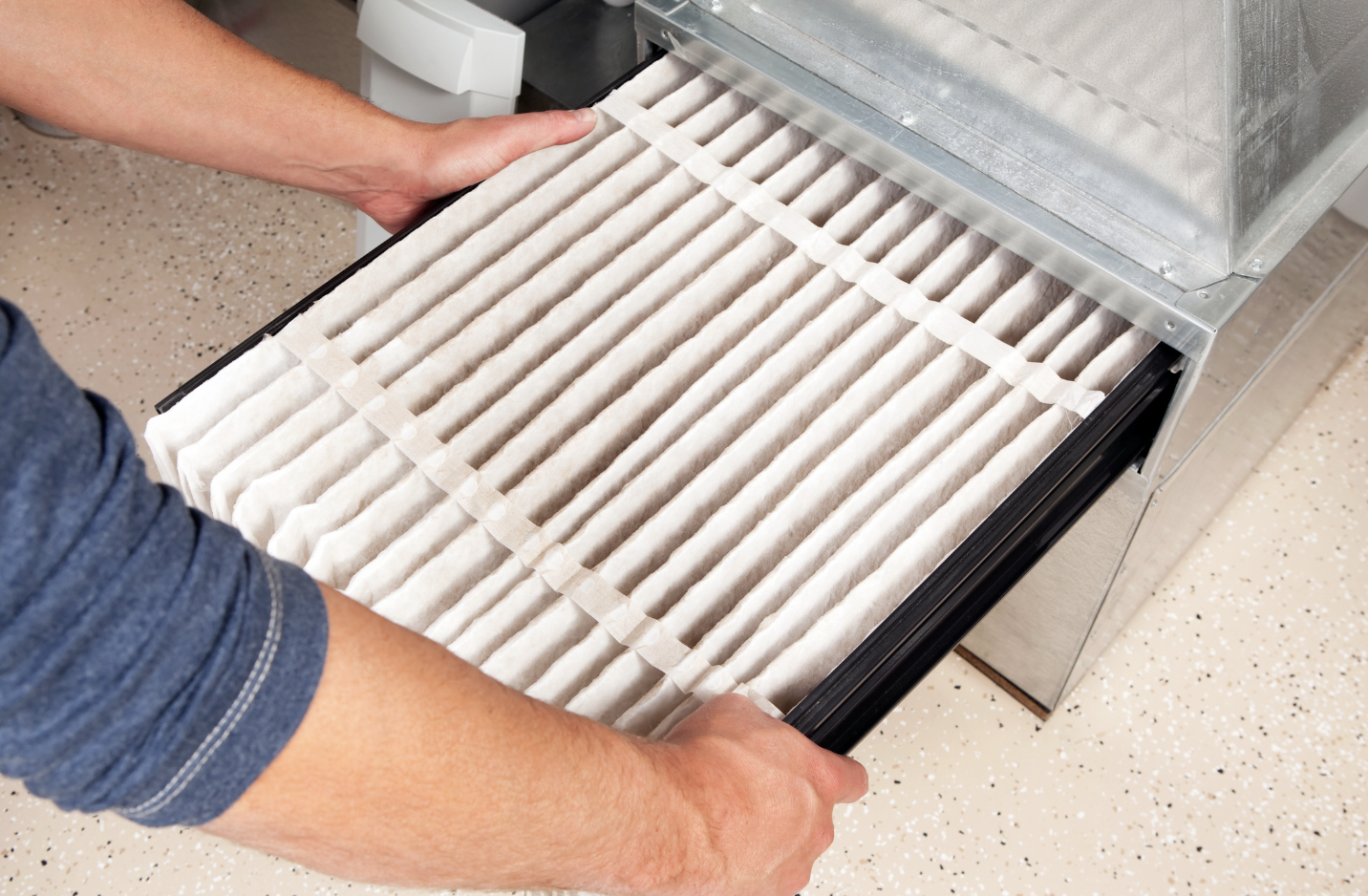
Using a filter that’s too strong can be bad for your furnace
The Big Mistake Most New Homeowners Make: Buying a Filter That's Too Good
Walk into any hardware store and you'll see filters organized by MERV rating - that stands for Minimum Efficiency Reporting Value. The higher the number, the more particles the filter captures. Sounds great, right?
Here's the thing… A filter that's too powerful can actually damage your furnace.
High-MERV filters (MERV 11, 12, 13 and above) are dense. They're designed to catch tiny particles - bacteria, smoke, fine dust. And they do that well. But all that density means your blower motor has to work significantly harder to push air through. It's like trying to breathe through a thick cloth versus a thin one.
For most residential HVAC systems - especially older ones common in established Twin Cities neighborhoods - the blower fan was designed to operate against a certain level of air resistance. Push that too far with an overly restrictive filter, and you get:
Reduced airflow and uneven heating throughout the home
The blower running longer to compensate
Increased wear on the motor
Higher electricity bills
Potential system failure over time
The HVAC industry refers to this as static pressure - and most residential systems aren't built to handle the static pressure created by ultra-high-MERV filters.
So Which Filter Should You Actually Buy?
For most homeowners in the Twin Cities metro, the sweet spot is a MERV 7 or MERV 8 filter.
That range catches the stuff that matters for home air quality - dust, pollen, mold spores, pet dander - without strangling your blower motor.
Here's the counter-intuitive truth: a cheaper filter that you replace regularly outperforms an expensive filter you leave in too long.
A fresh MERV 7 filter every 6 weeks does more for your air quality and your furnace's health than a MERV 13 filter you leave in for 6 months. The clogged filter is the problem - not the rating.
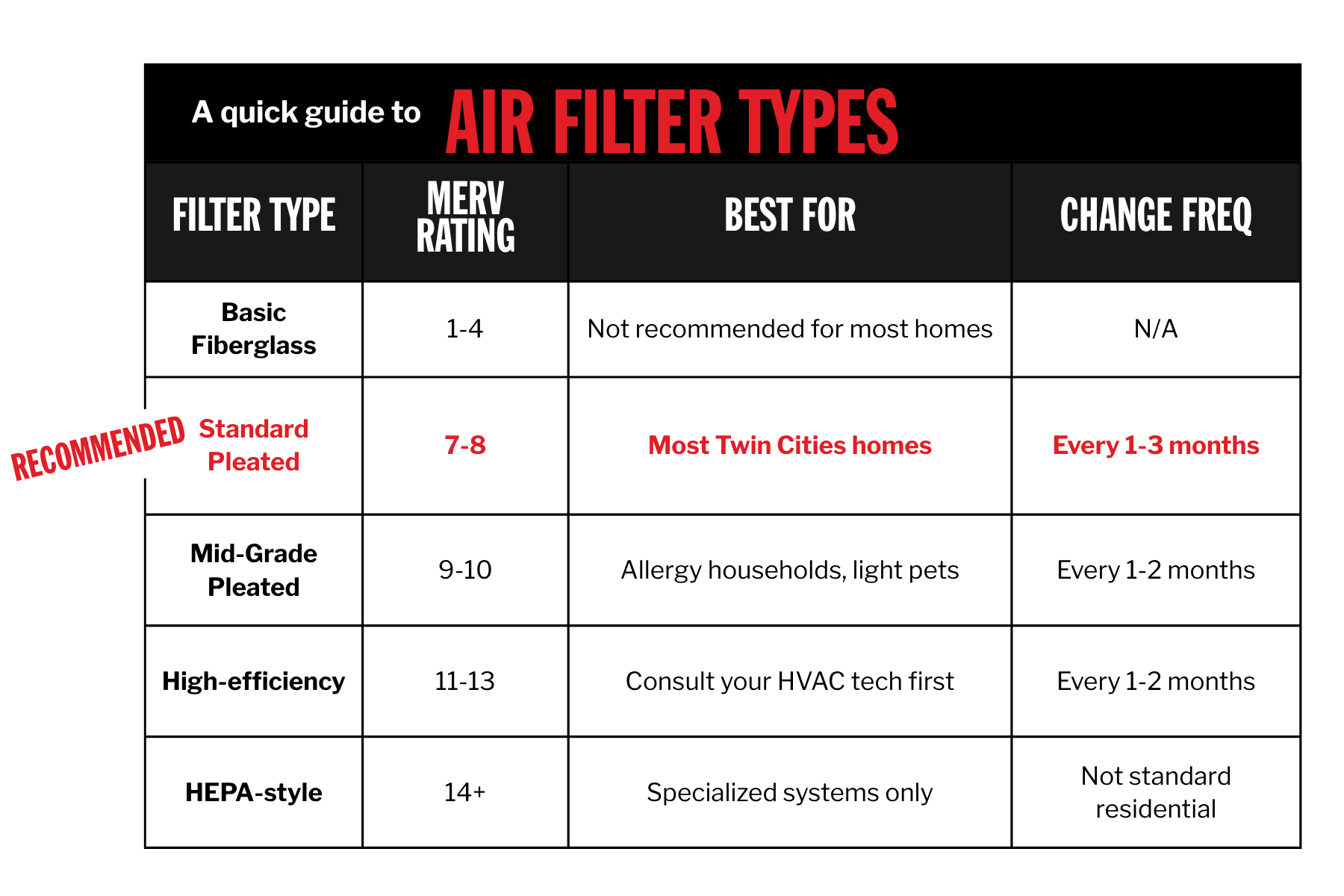
If you have specific allergy concerns and want to go higher than MERV 8, talk to an HVAC technician first. They can tell you whether your specific system can handle the added restriction - and some newer, higher-efficiency systems are designed for it.
A Few More Things Worth Knowing
Know your filter size before you go to the store. Filters are sized by length x width x depth (like 16x25x1 or 20x20x4). The size is usually printed on the side of the current filter. Write it down or snap a photo before you head out. Buying the wrong size is a rite of passage for new homeowners - skip it.
Don't buy washable/reusable filters unless you'll actually maintain them. Washable filters sound appealing - buy once, use forever. In practice, most people don't clean them often enough or thoroughly enough, and a damp filter sitting in a furnace is a mold risk. Stick with disposable.
Buy in bulk - or better yet, set up an Amazon subscription. Once you know your size and preferred MERV rating, buy a 6-pack or 12-pack online. Having filters on hand makes it easy to actually swap them out. When it's a trip to the hardware store, you'll put it off. When there's a filter sitting on a shelf in your utility room, you'll do it.
Even better: Amazon's Subscribe & Save lets you set up automatic deliveries on a schedule you choose - every 1, 2, or 3 months, whatever fits your replacement cadence. You save a few dollars per order, filters show up at your door, and you never have to think about it. It's one of those small automations that actually sticks. Set it and forget it.
Write the date on the filter with a marker when you install it. Old trick, works great. You'll always know exactly when it went in.
Check your filter if your energy bill spikes unexpectedly. A clogged filter is one of the first things to check. It's not always the reason, but it's a free and fast thing to rule out.
FAQ
What happens if I don't change my furnace filter? A clogged filter restricts airflow, making your furnace work harder. Over time this can lead to overheating, blower motor failure, and even cracked heat exchangers - which are expensive to repair and, in severe cases, a safety issue. In Minnesota winters, a furnace failure is not just an inconvenience. Stay on top of it.
Is a higher MERV rating always better for air quality? Not necessarily. A high-MERV filter installed in a system not designed for it can actually reduce air quality by restricting airflow - meaning the air in your home circulates less. A clean, appropriately rated filter changed regularly is almost always the better choice for typical residential systems.
Can I use any brand of filter as long as the MERV rating and size match? Yes. Filter brands don't matter nearly as much as size and MERV rating. Store brands and generics from warehouse stores work fine. Save the money and put it toward replacing them more frequently.
One Last Thing
Home maintenance doesn't have to be overwhelming. Furnace filters are genuinely one of the easiest wins - a $10 filter every couple of months protects a system that could cost thousands to repair or replace.
If you're a first-time homeowner in the Twin Cities and you're still figuring out the basics, that's completely normal. These are things nobody teaches you until you're standing in front of your furnace wondering what you're looking at.
And if you're still in the buying process - or thinking about making a move in the Eagan area, Dakota County, or anywhere across the metro - I'd love to be a resource. Whether you're ready to make an offer or just starting to think about what homeownership actually looks like, let's have a real conversation about it.
Reach out anytime.
Joe Schwartzbauer | GDP Homes
Serving Eagan, Dakota County, and the Twin Cities metro
joe@gdp.homes